
Sri Aurobindo
Vision and Teachings
Sri Aurobindo: His Life and Work

Sri Aurobindo has brought to the world the assurance of a divine future.
-The Mother
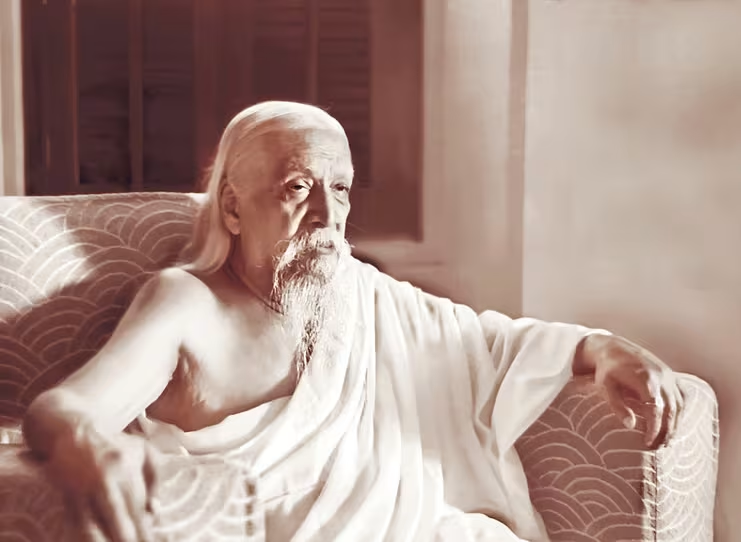 Sri Aurobindo, freedom fighter, writer, poet and yogi, envisioned and strove for a divine life on earth and spent the greater part of his life in Puducherry absorbed in this work.
Born on 15 August 1872 in Kolkata, India, Aravinda Ghose (as Sri Aurobindo was known until late 1926) was sent to England for his education when he was seven. In the course of a brilliant career at St. Paul’s School in London, and then at King’s College, Cambridge, he mastered not only English but also Greek, Latin and French, and became familiar with German, Italian and Spanish. He had already begun writing poetry at an early age. During his fourteen years in England, he gained a deep insight into the culture of ancient, mediaeval and modern Europe.
In 1893, at the age of twenty-one, Sri Aurobindo returned to India with a completely occidental education, but the moment he set foot on Indian soil, Mother India welcomed him with a unique spiritual experience. A vast calm descended upon him and remained with him for months afterwards. Sri Aurobindo now turned his attention towards the wisdom and truth of the Orient, learning Sanskrit and several modern Indian languages, and assimilated the spirit of Indian civilisation. The fourteen years he spent in what is now Vadodara in the administrative and educational service of the erstwhile Baroda State were years of self-culture and literary activity. A great part of the last years of this period was also spent, while on leave, in silent political activity.
In 1906, when he was thirty-four, Sri Aurobindo moved to Kolkata as Principal of the newly established Bengal National College but resigned soon after to participate openly in India’s struggle for freedom. He became a leader of the Nationalist Party, and his editorials in the daily Bande Mataram at once made him an all-India figure. In less than four years he revolutionised the moderate and ineffectual stand of the Congress Party, fixed in the national consciousness the goal of complete independence, and gave a new direction to the freedom movement. ‘Although he was on the high skies only for a time,’ observes Dr. Pattabhi Sitaramayya, the celebrated historian of the Indian National Congress, ‘he flooded the land from Cape to Mount with the effulgence of his light.’
The one-year detention, from 1908 to 1909, imposed on him by the British Government proved to be of immense significance. It was during this period that he underwent a series of decisive spiritual experiences which established the course of his future work. In 1910, assured of the ultimate success of the freedom movement and in answer to a command from Above, Sri Aurobindo withdrew from political activities, for it was now his rule to move only as he was moved by the Divine guidance. He eventually sailed for what was then Pondicherry, today’s Puducherry, to devote himself entirely to his spiritual mission.
In 1914, after four years of silent Yoga, he started the philosophical monthly Arya, through which he revealed his new message for humanity: man’s divine destiny, the theme later expanded in his book, The Life Divine. Among his other works, The Synthesis of Yoga looks at the path to its realisation, while The Human Cycle takes up the progress of human society towards a divine future. The realisation of the oneness of humankind is the subject of The Ideal of Human Unity, and the inner meaning and significance of Indian spirituality and civilisation are revealed in The Foundations of Indian Culture, The Secret of the Veda, The Upanishads, and Essays on the Gita. The Future Poetry considers the nature and evolution of poetry. His supreme work in poetry, Savitri – A Legend and a Symbol, is an epic of nearly 24,000 lines in blank verse, in which he takes a small episode from the Mahabharata and turns it into a symbol of the human soul’s spiritual quest and destiny.
In the midst of all this work, he also kept a close watch on all that was happening in India and the world, actively intervening, but with a silent spiritual force and action, whenever necessary. Sri Aurobindo left his body in 1950, but his vision and ideals, relevant for all time, continue to attract people from all over the world.
Sri Aurobindo’s Teaching
Like his personality, the teaching of Sri Aurobindo is multifaceted and all-embracing but unified by his central vision of a spiritual and divine destiny which must evolve. His teaching states that behind the appearances of the universe there is a Divine Truth-Consciousness, a Self of all things, one and eternal. This Consciousness is involved here in Matter. Evolution is the method by which it liberates itself. Life is the first step of this release of consciousness; mind is the second; however, the evolution does not finish with mind, but awaits a release into something greater, a consciousness which is spiritual and supramental.
What Nature achieves through a slow and laborious evolution, Yoga effects for the individual by a rapid inner transformation. The object of Sri Aurobindo’s Integral Yoga is not only to rise out of the ordinary ignorant world-consciousness into the higher Truth-Consciousness, but also to bring down this Truth-Consciousness on earth, to fix it here, so as to create a new individual and collective life in all its richness and manifold dimensions.
Sri Aurobindo committed almost his whole life to establishing upon earth this Truth-Consciousness, which he called Supramental, and to help those around him to realise it for a perfectly harmonious, beautiful and fully conscious life. For it is only the descent of the Supermind which can create the perfection dreamt of by all through the ages, and remould not only the individual but also his social existence into a divine pattern.
It is not Sri Aurobindo’s object to develop any one religion or to amalgamate the older religions or to found any new religion – for any of these things would lead away from his central purpose. The one aim of his Yoga is an inner self-development by which each one who follows it can, in time, discover the One Self in all, and evolve a higher consciousness than the mental, a spiritual and supramental consciousness which will transform and divinise human nature.
You have the Word and we are waiting to receive it from you. India will speak through your voice, hearken unto me!
Rabindranath Tagore to Sri Aurobindo
“Sri Aurobindo has come to tell us: “It is not necessary to leave the earth to find the Truth, it is not necessary to leave life to find one’s soul, it is not necessary to give up the world or to have limited beliefs in order to enter into relation with the Divine. The Divine is everywhere, in everything, and if He is hidden, it is because we do not take the trouble to discover Him.”
-The Mother
Based on 2345 reviews
Based on 1234 reviews
Find us on Facebook
Follow us on Instagram